
Major Spotlight: French
The French major may be small (my year has eight majors!), but the faculty and students in the department create a warm, encouraging community that has supported me all four years at Barnard. Taking French has truly been one of the most important aspects of my time here: I made many close friends, bonded with professors, and strengthened my fluency level and confidence. I have a fondness for the third floor of Milbank and all of the classes I have taken in the department.
Most students who take the two required semesters of language decide they want to continue with the more advanced courses in the department; French is very popular as a minor election as well. And, if you study abroad in France or a Francophone country, it is incredibly easy (and fun!) to complete a major or minor.
French Major Fundamentals
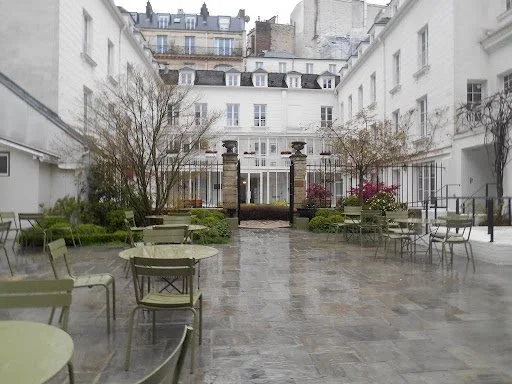
Rainy courtyard at Reid Hall, Columbia’s campus in Paris
For the major or the minor, all courses must be at the 3000 level or above. This means that the language acquisition courses, from Elementary I to Intermediate II, do not count for the major requirements. However, it is still possible to complete a minor in French if you come to Barnard with zero French experience!
Major French Texts I and II are staples of the French major. These courses cover texts from the medieval era up until the late 19th century to help solidify a canon of French literature, ie. “major texts.” I didn’t anticipate how much I would enjoy reading the early fairy tales of Marie de France and analyzing Renaissance poems in French. Besides these two courses, a mix of advanced language, literature, and culture courses are required. I especially loved Advanced Oral French with Prof. Anne Boyman, where we practiced the phonetics and sonorities of French, and Women of the Left Bank with Prof. Hadley Suter, a course focusing on the art, philosophy, and sexualities of turn-of-the-century women.
After four years at Barnard, my favorite course overall (tied with Greek Art and Architecture…shoutout Art History) was Women Writers of the Contemporary Middle East and North Africa with Prof. Mélanie Heydari. This class melded lecture and discussion as we read challenging texts from Nawal El Saadawi, Negar Djavadi, Isabella Hammad, and more. I had first read sections of the graphic novel Persepolis by Marjane Satrapi in my first year at Barnard: to return to this text as a senior, being able to confidently analyze the words and pictures, I felt the weight of the language education I had received.
Studying Abroad
Studying abroad in France was an incredibly formative and fulfilling experience: see here for a Day in My Life from last year! Not only did I build deep connections with others and navigate a foreign country, but I also completed my French major by participating in a full immersion program. Columbia’s campus in Paris, Reid Hall, is a very welcoming environment, and I was able to take advantage of grammar and language classes, as well as engaging in content-based courses at both Reid Hall and a local university. I was even able to find inspiration for my Art History thesis when exploring the many museums and while taking the course, The Age of Enlightenment, taught by Prof. Séverine Martin.
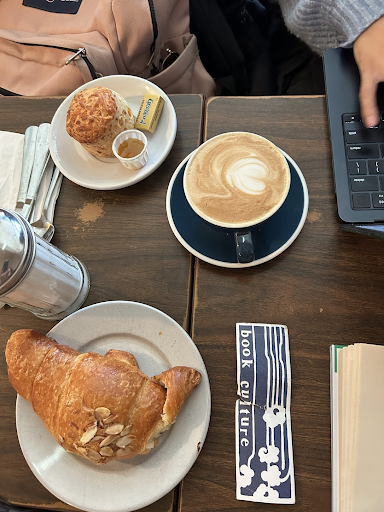
Almond croissant and studying at Hungarian Pastry Shop: finding ways to bring the French major into the everyday
Thesis Capstone
Though I am currently writing two theses as a senior double major, I can honestly say that the French thesis has been a joy to write. Students can choose between two options: a translation project or a more classic literature/culture analysis. My thesis consists of a French-to-English translation of a source written by the artist Pierre-Nolasque Bergeret in 1848 and an approximately 10-page translator’s note in French. I meet one-on-one with my advisor to discuss possible translation theory and issues, but I also love to chat with the other senior French majors/my friends about our projects.
I did not expect to be a French major when I first came to Barnard. I found a second home in Paris, and I still felt comfortable and integrated with the community there when I visited for spring break this year. From the simple act of being able to order in a restaurant to the experience of writing up French citations as a research assistant, I am so grateful for the opportunities the French department has provided me.